Two Major Dust Storms Slam Phoenix in Five Days
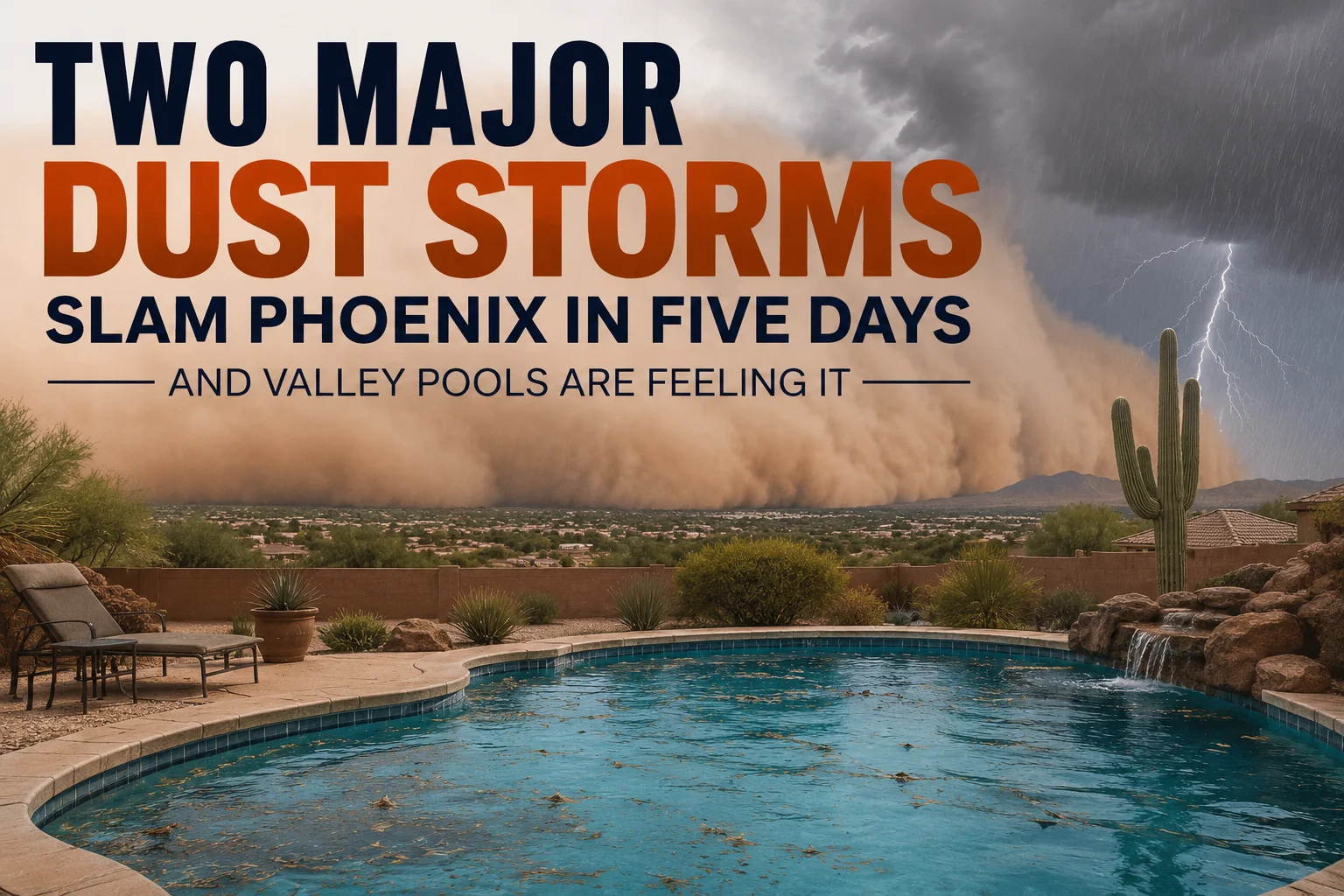
Two Major Dust Storms Slam Phoenix in Five Days — and Valley Pools Are Feeling It
Phoenix-area pool owners have been given a harsh reminder of what Arizona’s monsoon season can do.
Within just five days, two significant walls of dust swept across the Phoenix metropolitan area, bringing strong winds, extremely low visibility and, in some locations, heavy rain and storm damage.
The first arrived on Wednesday, August 19, 2026, as a powerful complex of thunderstorms developed east and southeast of the Phoenix metro. The second moved through on the evening of Sunday, August 23, once again pushing a wall of dust across much of the Valley.
For Arizona homeowners with swimming pools, the effects can continue long after the sky clears.
August 19 Storm Brought Damaging Winds Across Phoenix
The August 19 storm was the more powerful of the two events.
According to the National Weather Service Phoenix, a large cluster of strong to severe thunderstorms developed east and southeast of Greater Phoenix.
Those storms generated a large outflow boundary that traveled west-northwest across the entire metro area.
The result was widespread straight-line winds primarily between 55 and 65 mph. Phoenix Sky Harbor International Airport recorded a wind gust of 68 mph.
The winds also picked up enormous amounts of desert soil and debris, creating a significant dust storm across the Valley.
Visibility dropped below one mile in numerous locations. In portions of the East Valley, visibility fell below one-quarter mile. The National Weather Service documented extremely poor visibility near Loop 202 and Power Road in East Mesa.
Chandler, Mesa, Tempe and Phoenix Were in the Storm’s Path
The storm wasn’t limited to one section of the Valley.
National Weather Service warnings included communities throughout the Phoenix metro, including Phoenix, Chandler, Mesa, Gilbert, Tempe, Scottsdale, Glendale, Avondale and Apache Junction.
Rain followed the dust and wind in many locations.
According to the National Weather Service, portions of the Central and East Valley received approximately 0.50 to 1.30 inches of rain, while Phoenix Sky Harbor International Airport officially recorded 0.56 inches.
The winds were powerful enough to uproot trees and damage structures. The National Weather Service documented an uprooted tree near Dobson and Warner roads in Chandler and roof damage at Marcos de Niza High School in Tempe.
Power outages were another major consequence. KTAR News reported that more than 30,000 Valley utility customers were affected by outages at the height of the storm.
Then Phoenix Got Hit Again
Just four days later, another wall of dust entered the Valley.
On Sunday evening, August 23, storms originating to the southeast produced an outflow boundary that traveled northwest toward metro Phoenix.
A dust storm warning covered a large portion of the Valley, stretching from the East Valley toward Avondale and north Phoenix.
According to KTAR News, the National Weather Service warned of sharply reduced visibility as the wall of dust moved through the metropolitan area.
Unlike the August 19 storm, however, this event produced relatively little widespread rainfall.
Arizona’s Family reported strong winds and blowing dust across the Valley Sunday evening, with scattered showers developing behind the dust.
Phoenix Sky Harbor eventually recorded just 0.04 inches of rain.
According to KTAR News, that brought Phoenix’s official 2026 monsoon rainfall total to 1.25 inches, approximately 0.4 inches below normal for that point in the season.
Two Dust Storms Can Mean a Lot of Work for Pool Owners
Anyone who owns a swimming pool in Arizona knows what comes next.
Dust doesn’t simply disappear when a haboob passes.
Fine desert particles can settle across the surface of a swimming pool before eventually sinking to the floor or being pulled into the circulation system. Leaves, branches and other windblown debris can also enter the pool.
After two significant dust events in less than a week, pools throughout Phoenix, Chandler, Mesa, Gilbert, Tempe, Scottsdale and surrounding communities may require additional attention.
Pool owners may notice:
- Dirt or sediment accumulating on the pool floor
- Cloudy or dull-looking water
- Debris floating on the surface
- Rapidly filling skimmer baskets
- Higher filter pressure
- Reduced circulation
- Dirty cartridge filters
- The need for additional vacuuming or cleaning
The August 19 storm added another complication: rainfall.
Rainwater, windblown debris and large quantities of dust entering a pool at the same time can increase the workload placed on the filtration system.
What Should You Do After a Phoenix Dust Storm?
Start with the obvious debris. Remove leaves, branches and larger material from the surface and pool floor before allowing it to continually circulate through the system. Arizona dust can place an especially heavy burden on pool filtration systems following a major monsoon storm.
Check the skimmer and pump baskets as well. A basket packed with storm debris can restrict water flow. Next, look at your filter pressure. If pressure has increased substantially compared with your pool’s normal clean operating pressure, the filter may need to be cleaned or backwashed according to the manufacturer’s instructions.
Pool owners should also test their pool water after a significant monsoon storm, particularly when rain accompanies the dust. If you don’t test your water at home, you can find a pool supply store in Phoenix that may offer professional water testing and pool chemicals.
Extremely fine Arizona dust can take time to remove. Depending on how much entered the water, additional brushing, vacuuming and filtration may be necessary before the pool looks normal again. Homeowners who need professional help can compare pool cleaning companies in Phoenix that provide cleaning, vacuuming, filter service and routine pool maintenance.
If your pool remains cloudy, circulation appears weak or you’re simply unsure what to do after the storm, you can also ask the AZ Pool Advisor community and share details or a photo of what’s happening with your pool.
The Dust Itself Can Be the Storm for Arizona Pools
Arizona’s official monsoon season runs from June 15 through September 30, which means Valley pool owners aren’t out of the woods yet.
The recent storms also demonstrate something important about Arizona monsoons: a storm doesn’t have to dump heavy rain over your house to create problems for your swimming pool.
The August 23 event is a perfect example. Phoenix received very little measurable rainfall, yet a large portion of the metropolitan area still experienced significant blowing dust.
For Arizona swimming pools, the dust itself can be the storm.
After two major dust events swept through the Valley within days of each other, now is a good time for Phoenix-area pool owners to inspect their water, skimmer baskets, filters and circulation systems — before the next wall of dust arrives.
Sources
- National Weather Service Phoenix — August 19, 2026: Widespread Strong to Severe Winds and Dust Storm in the Phoenix Area
- KTAR News — Monsoon storms and Phoenix-area power outages
- KTAR News — August 23 Valley dust storm
- KTAR News — Phoenix monsoon rainfall and August 23 storm
- Arizona’s Family — Phoenix gets dust and rain from Sunday storm system